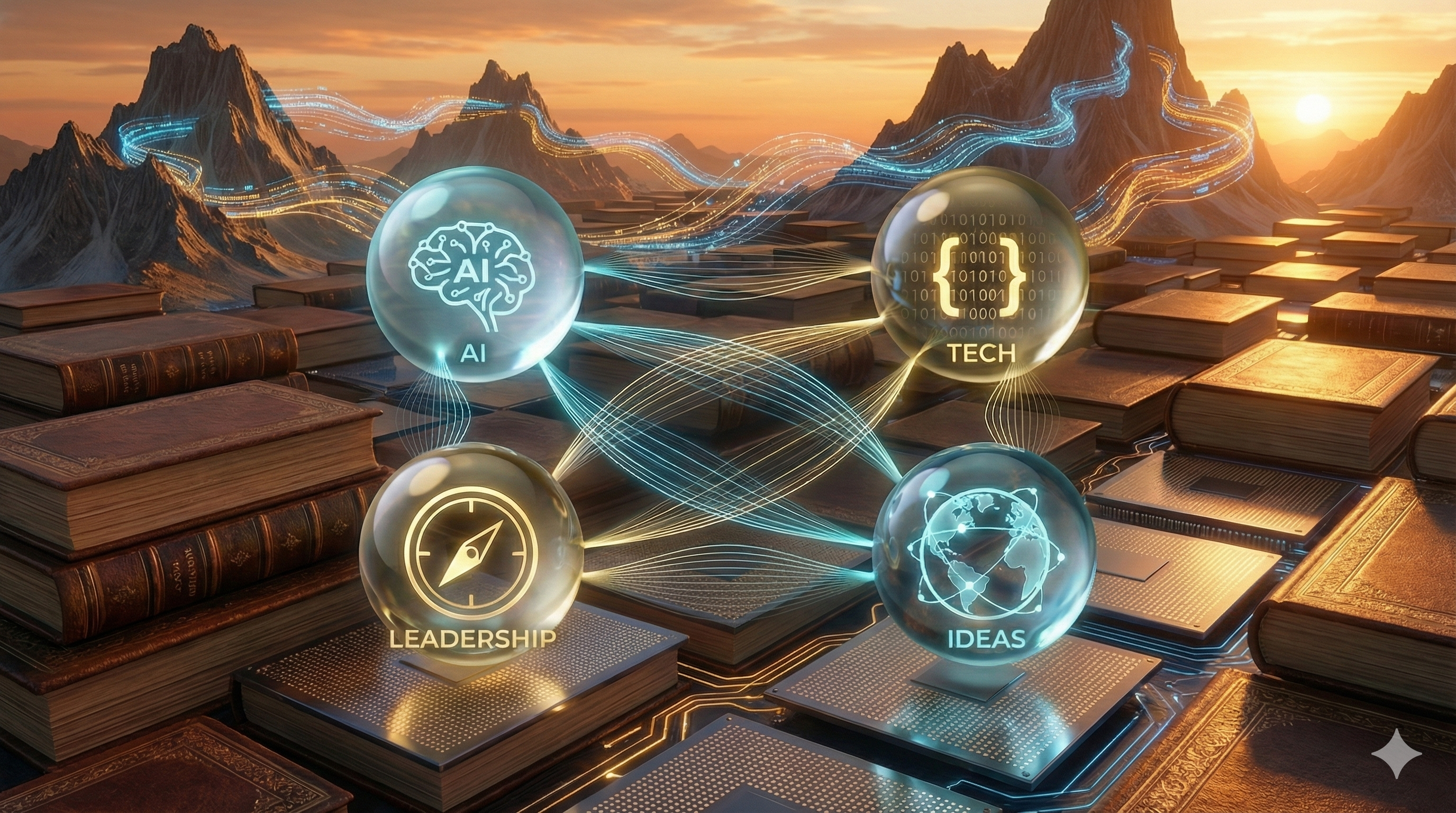
It has been quite a while since I last shared a reading list on this blog. In the fast-paced world of technology, it’s easy to get caught up in the stream of papers and newsletters, but I’ve always found that books provide the necessary depth and historical context to truly understand where we are heading. As I sat down to synthesize my recent readings, I realized that the core themes converged into what I’ve started calling my “A-List” of recent books: Abundance, Anxiety, AI, and Algorithms. It’s a playful alliteration, but one that captures the profound tension between the potential for technological plenty and the societal costs we are only beginning to calculate. Over the past few months, I’ve been diving into a diverse set of titles that help decode these four forces, categorizing them into AI, Tech, Leadership, and “Other Important Ideas.”
AI and the AI Revolution
The current revolution isn’t just about code; it’s about the fundamental nature of intelligence and the hardware that powers it.

- “What is Intelligence: Lessons from AI about Evolution, Computing, and Mind” by Blaise Aguera y Arcas: My former colleague at Google, Blaise, delivers an incredible deep dive into the meaning of life through the lens of computation. It’s a profound look at how AI helps us redefine what it means to be alive and intelligent.
- “A Brief History of Intelligence:: Evolution, AI, and the Five Breakthroughs That Made Our Brains” by Max S. Bennett: A great companion to Blaise’s book, focusing on the five breakthroughs that shaped our brains.
- “Chip War: The Fight for the World’s Most Critical Technology” by Chris Miller: To understand the AI revolution, you must understand the silicon. Miller provides a fascinating look at how companies like TSMC, ASML, and NVIDIA reached their current dominance and how these dynamics are shaping global geopolitics.
- “The Nvidia Way: Jensen Huang and the Making of a Tech Giant”): For those of us living and breathing the AI revolution from the inside, this history of NVIDIA is essential reading. It serves as a perfect companion to Chris Miller’s Chip Wars; while Miller provides the macro-perspective of the silicon landscape, this book dives deep into the specific company culture and technical bets that allowed NVIDIA to dominate that landscape.
- “The Optimist: Sam Altman, OpenAI, and the Race to Invent the Future”: More than an authorized biography, this is a detailed history of the characters and moments that shaped OpenAI and modern Silicon Valley.
- “The Singularity is Nearer” by Ray Kurzweil: A long-awaited update to his classic thesis on the merging of human and machine.
- “The Worlds I See” by Dr. Fei-Fei Li: A beautiful memoir about curiosity and the dawn of modern AI from one of the field’s most important pioneers.
- “Nexus” by Yuval Noah Harari: Harari looks at information networks from the Stone Age to AI, providing his usual sweeping historical perspective.
- “Co-Intelligence” by Ethan Mollick: One of the most practical guides out there for actually living and working alongside AI today.
Tech and Its People
Understanding tech often requires understanding the “DNA” of the institutions and individuals that built it.

- “The Idea Factory” by Jon Gertner: A look back at Bell Labs, the original powerhouse of American innovation.
- “Elon Musk” by Walter Isaacson: Regardless of your personal opinion of him, Isaacson’s biography explains a lot about his trajectory and the “demon mode” that drives his companies.
- “This is For Everyone” by Tim Berners-Lee: I stumbled upon this recently. It’s the story of the WWW told by the man who invented it—covering the past, present, and his vision for the future.
- “In the Plex” by Steven Levy: Even though it’s missing the last 15 years, it remains one of the best books for understanding Google’s foundational culture.
- “Careless People: A Cautionary Tale of Power, Greed, and Lost Idealism by Sarah Wynn-Williams”: A raw, personal account of Meta’s cultural stumbles from someone who had a front-row seat to the internal dynamics.
- “Source Code: My Beginnings” by Bill Gates: A fascinating look at the early life of Bill Gates and the birth of Microsoft. I learned quite a bit I didn’t know about his early years.
- “Pattern Breakers: Why Some Start-Ups Change the Future” by Mike Maples Jr. and Peter Ziebelman: An insightful look at why some startups manage to change the future while most fail.
Leadership, Culture, and Human Nature
As I discussed in my Challenge-Inspire model post, leadership is about more than just task management; it’s about understanding the human element.

- “Reset: How to Change What’s Not Working” by Dan Heath: This is a very practical book on changing systems—like our teams—that aren’t working optimally. It focuses on finding leverage points to drive real change. Highly recommended.
- “The Laws of Human Nature” by Robert Greene: A comprehensive guide to understanding behavior and communication. It’s dense with historical references and provides great advice on how to bring out the best in people.
- “Supercommunicators” by Charles Duhigg: A recent bestseller that provides a great framework for connecting with others.
- “How to Know a Person” by David Brooks: A very personal guide on how to foster deeper connections. Brooks acknowledges his own challenges in this area, which makes his tips and advice feel very grounded and earned.
- “First, Break All the Rules” by Marcus Buckingham: A classic that still holds up regarding what great managers do differently.
- “How to Decide” by Annie Duke: More tools for the decision-making toolkit, which you know is a favorite topic of mine.
- “Start with Why” by Simon Sinek: A foundational text on how great leaders inspire action.
Other Important Ideas
Finally, a few books that have challenged my perspective on the broader world.

- “Capital in the 21st Century” by Thomas Piketty: This was proposed for a book club, and at 700 pages, it was daunting. However, I was pleasantly surprised. It’s a deeply researched work on macroeconomics and inequality that provides the essential historical background and context for more contemporary shifts.
- “Abundance” by Ezra Klein: With Piketty’s historical lens in place, Klein’s “Abundance” is a fascinating read. While it may appear techno-optimistic on the surface, its main lesson for me was how easily well-intentioned policies can falter when built on incorrect assumptions about the future—a critical takeaway as we navigate a world reshaped by AI and automation.
- “The Anxious Generation” by Jonathan Haidt: This is a critical look at how the “rewiring of childhood” via technology is impacting mental health. It serves as a stark counter-narrative to the techno-optimism of Ezra Klein; while Klein focuses on the potential for abundance, Haidt exposes the very real dangers and social costs of unbridled technological adoption. The book has become extremely influential, acting as a catalyst for new legislation and policy changes regarding smartphone and social media usage for minors around the world.
- “The End of the World is Just the Beginning” by Peter Zeihan: A provocative mapping of the potential collapse of globalization. He argues that the era of global trade and secure transport is a historical outlier that is rapidly ending due to demographic shifts and changing US policy. It provides a broader, macro-strategic complement to Miller’s Chip Wars; while Miller focuses on the specific geopolitical struggle over silicon, Zeihan maps the decaying global order that makes that struggle so volatile.
- “The Vital Question” by Nick Lane: A technical but rewarding explanation of how life came to be, focusing on energy constraints rather than just information. Lane argues that the leap from simple to complex life was a rare, energetic fluke, requiring a level of power that standard evolution struggled to achieve. The book has received immense critical acclaim, most notably from Bill Gates, who famously claimed it was the best book he’d read in years and that it would “help people understand that energy is as fundamental as information.”
I hope you find something in this list that sparks your curiosity. As always, I’m curious to hear what you’ve been reading. Are there any books that have fundamentally shifted your perspective lately? Let me know in the comments!
Comments